
Recover the usable site
Download HTML and linked assets, remove archive replay wrappers, and rewrite internal paths for a standalone result.
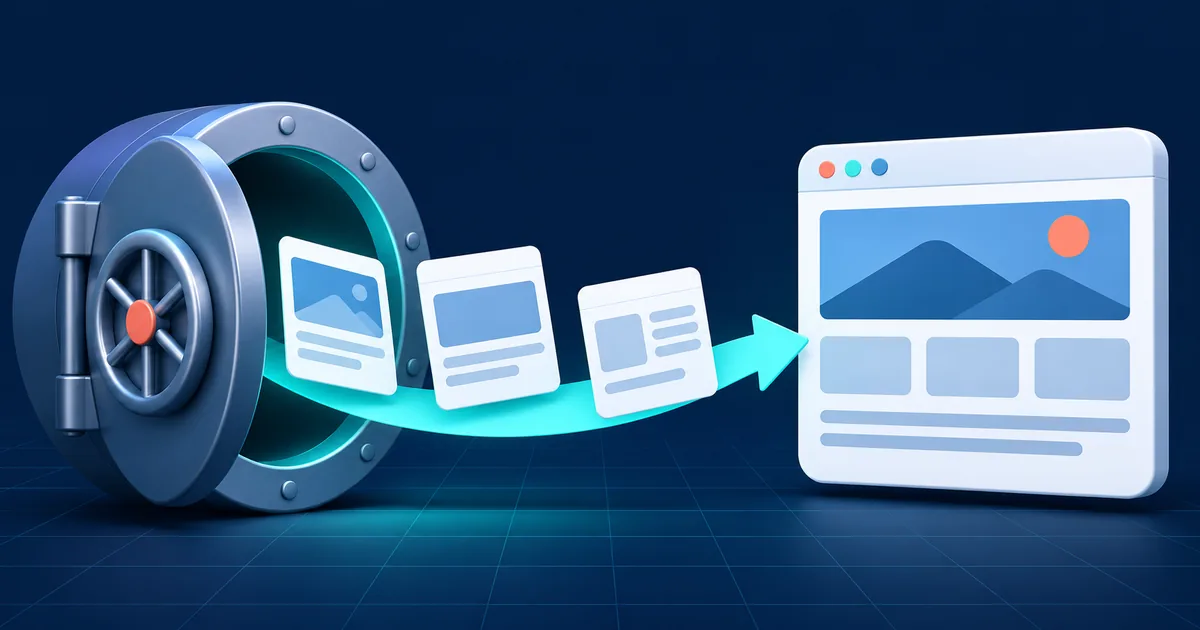
Recovery result: Archive Downloader rebuilds authorized public pages and captured assets from one exact Wayback Machine URL, then delivers portable files, a source manifest, and a missing-file report.
It delivers a standalone website package, a traceable record of captured and missing files, and the project structure selected for future maintenance.
Download HTML and linked assets, remove archive replay wrappers, and rewrite internal paths for a standalone result.
Receive a manifest that records capture dates, response status, local paths, substitutions, and unresolved resources.
Choose static HTML, WordPress, React, Next.js, Flask, Django, Vue, or Astro. We reconstruct the complete recoverable website in that selected project structure.
New to archive recovery? Read the Wayback Machine downloader guide before choosing a capture, or test one archived homepage with the free front-page rebuild.
A delivery is more than a ZIP file. It includes the portable website, a record of where each recoverable file came from, and clear evidence for anything the archive could not supply.
| Recovery area | What you receive | How to verify it |
|---|---|---|
| Pages and assets | Recovered HTML, CSS, JavaScript, images, fonts, and public downloads that exist in the approved capture scope. | Open the portable site without Wayback Machine replay wrappers and compare each local file with its source entry. |
| Routes and links | Rewritten internal paths, a redirect plan for changed URLs, and a sitemap for successful canonical pages. | Crawl the delivered package and review broken links, redirect targets, canonicals, and status results. |
| Recovery evidence | A manifest with the original URL, selected capture, response status, local path, substitutions, and exclusions. | Use the missing-file report to separate an archive gap from a deliberate scope or safety decision. |
| Protected delivery | A password-protected ShareIt download containing the site files and reports, retained for 90 days after creation. | Download the package, confirm the password, and keep an independent backup before the retention period ends. |
Compare static recovery, WordPress conversion, and complete framework rebuilding before placing an order.
The workflow validates one exact capture, inventories recoverable URLs, repairs the package, and verifies that the result no longer depends on archive replay services.
Parse the capture timestamp and original hostname, then confirm that the request stays within the authorized domain.
Discover internal pages and dependencies while normalizing duplicate URLs, redirects, and archive modifiers.
Rewrite archive paths, recover nearby assets when justified, and record every gap instead of silently inventing content.
Check representative templates, mobile layouts, links, metadata, sitemaps, and offline independence before delivery.
Start with archive recovery when the live site is gone, use the free demo to test one homepage, use website cloning for an authorized site that is still online, or convert source files you already possess.
Submit one exact dated Wayback Machine capture. The downloader inventories public pages and dependencies, then lets you define the domain, path, date, repair, SEO, and output options.
Configure a Wayback Machine downloadUse a free front-page rebuild to inspect the homepage and its required public styles, scripts, and images before deciding whether a complete recovery is justified.
Create a free front-page demoUse the live-site service only for a public website you own or have written permission to rebuild. It identifies the observable technology stack and creates original replacement visuals.
Review the authorized website cloning serviceUpload an owned HTML, CSS, and JavaScript package when the content is available but the project needs a maintainable Astro, SvelteKit, React, Next.js, Vue, Python, PHP, or WordPress structure.
Compare website conversion formatsA public capture can document pages and browser assets. It cannot reveal a private database, passwords, unpublished server code, or the rules behind an account, checkout, search, or form system.
Logins, payments, form processing, private APIs, databases, and admin tools must be designed and tested as current software when their source and data are unavailable.
When the archive has no usable response for an in-scope file, the report records the gap. It is not silently replaced with invented historical content.
Use the service only for a website you own or are authorized to restore. Third-party media, personal data, licensed files, and old claims still require review before republication.
Confirm the publication boundary with the website recovery authorization checklist, then follow the complete website restoration workflow.
These useful service, guide, article, and policy pages rotate daily. The complete public library is organized on the Archive Downloader sitemap.
Understand how account, recovery, delivery, and retained file information is handled.
Open privacy policyReview authorization, archive limitations, retention, and customer responsibilities.
Open terms of serviceTest one archived homepage and its required public assets before ordering a complete recovery.
Open free wayback machine front-page rebuildValidate one exact dated capture and configure an authorized website recovery.
Open wayback machine downloaderReconstruct a live public website in its detected technology stack with original replacement visuals.
Open clone an authorized live websiteTurn owned HTML, CSS, and JavaScript files into a maintainable framework project.
Open website stack converterPaste one exact Wayback Machine replay URL. We verify the archived domain and capture date before you choose any recovery options.