
How to use this website recovery glossary
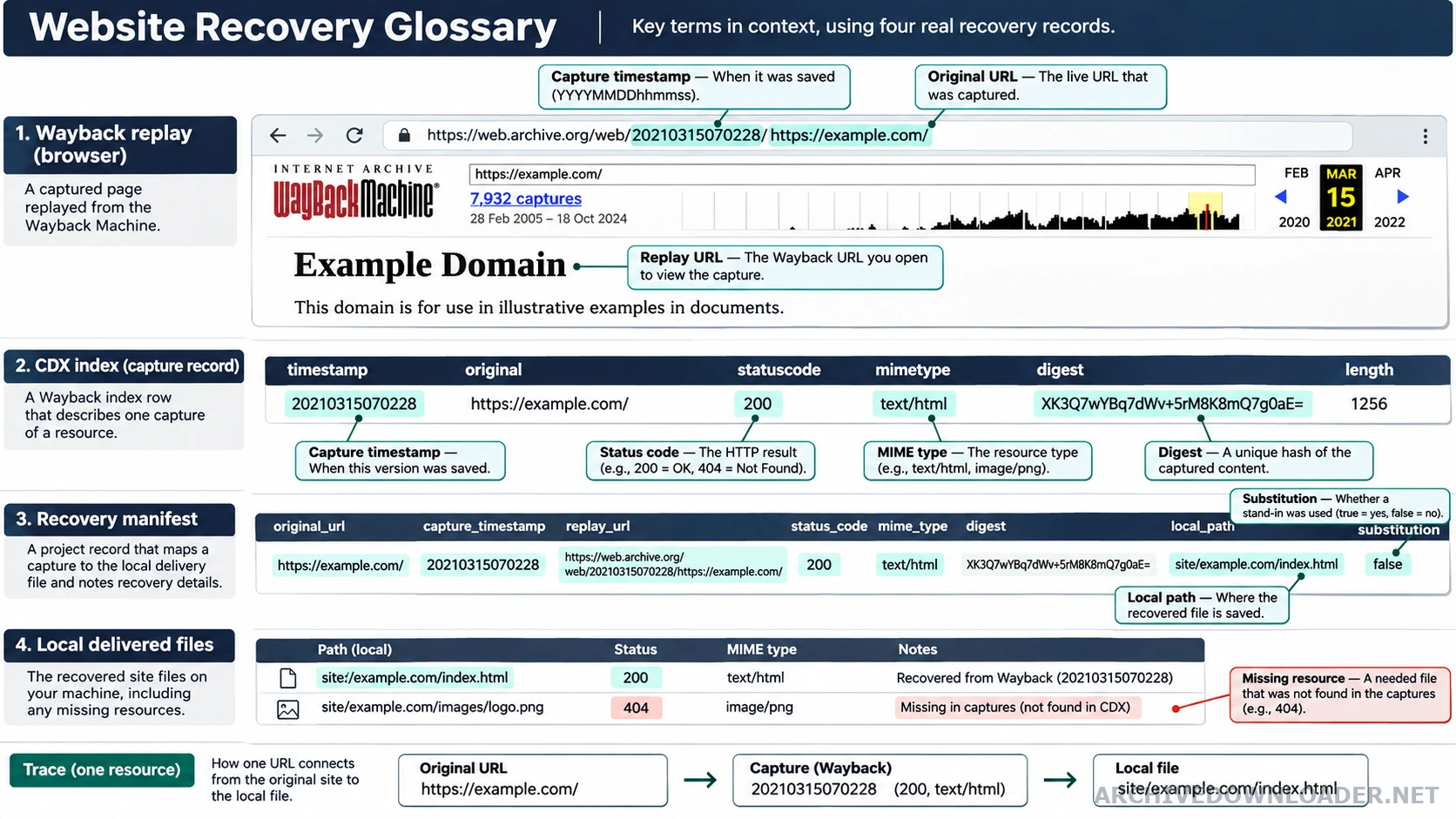
Website recovery uses terms from web archives, crawling, software delivery, and technical SEO. This glossary defines those terms as they are used in an authorized rebuild. It also separates an archived observation from a conventional hosting backup, which may contain databases and private server files that a public capture cannot provide. Use the Wayback Machine URL format guide to separate the timestamp, replay modifier, and original URL before saving any file.
Start with the exact capture URL and capture timestamp when checking one archived page. Use the CDX record, original URL, MIME type, and response status when building a larger inventory. Use the recovery manifest, redirect map, and archive-independence test when reviewing a delivered website. Then use the CDX API recovery guide to turn discovery records into a bounded, reviewable capture inventory.
The three records that make a recovery auditable
A capture record identifies the archived response selected for a page or asset. A recovery manifest connects that source response to the delivered local file. A missing-file report explains requests that could not be recovered or were intentionally excluded. Together, these records let a reviewer distinguish archive evidence from later repairs and newly implemented behavior. Apply those terms to one exact authorized source in the Wayback Machine downloader before estimating pages or selecting a recovery plan.
Definitions do not prove that a website is complete. A recovery still needs a written host and path boundary, representative page checks, asset verification, permission to republish, and a network test that blocks Archive.org and the lost origin.
Website recovery terms
Use these definitions when reading an archive inventory, recovery manifest, or rebuild proposal.
Wayback Machine capture
A timestamped public response stored by the Wayback Machine for one original URL. A capture is evidence of what the archive crawler received at that moment, not a full copy of the server.
Compare candidate snapshotsExact capture URL
A replay URL containing a complete 14-digit timestamp and one original URL. An exact capture URL does not contain an asterisk and can be checked again later.
Parse archive URL formatsWildcard capture URL
An archive address containing an asterisk that represents a calendar, list, or range of captures instead of one reproducible response. It must be replaced with an exact dated capture before a rebuild starts.
Choose an exact URLCapture timestamp
The 14-digit UTC date and time in a Wayback Machine replay URL. It records when the archive captured the response and helps detect files drawn from a different design period.
Original URL
The address requested from the historical website after the archive host, timestamp, and replay modifier are removed. It supplies the original scheme, hostname, path, and query for recovery mapping.
Replay URL
An address on web.archive.org that serves an archived response. A delivered website should use its own local or final public URLs instead of continuing to request replay URLs.
Replay modifier
A short archive instruction attached to a capture timestamp that changes how a stored response is replayed. Recovery software must parse the modifier separately from the original URL.
CDX record
A discovery record describing an archived URL and capture with fields such as timestamp, status, MIME type, digest, and redirect target. A CDX record is an inventory lead, not proof that the replay is complete.
Use CDX records safelyMIME type
The response content type, such as text/html, text/css, application/javascript, or image/webp. It helps prevent an HTML error response from being saved as an image, stylesheet, or script.
Archive asset
A captured file required by an archived page, such as a stylesheet, image, font, script, document, or media file. Asset recovery must preserve correct paths and content types.
Nearby capture substitution
The documented use of a different timestamp for a missing page dependency. The substitution should stay within the approved date policy and remain visible in the recovery manifest.
Recovery manifest
A table that maps each requested original or replay URL to its capture timestamp, response result, delivered path, and final disposition. It is the evidence trail for the recovered package.
Missing-file report
A list of in-scope pages and assets that were unavailable, invalid, excluded, or unsafe to deliver. Removing a broken element from the visual result should not remove it from this report.
Crawl boundary
The approved hostnames, subdomains, path prefixes, dates, and file types that a recovery process may discover. A clear boundary prevents unrelated sites and duplicate URL variants from inflating the job.
Redirect map
A one-to-one plan connecting an old public URL to its closest equivalent final URL and status. URLs without an equivalent should return a real not-found or gone response instead of all redirecting to the homepage.
Orphan page
An in-scope page found in archive indexes but not reachable through the recovered internal navigation. It requires editorial review before inclusion because discovery alone does not prove current value.
Archive independence
The condition in which the delivered site can load its pages and required assets without calling Archive.org or the lost origin. It is verified with network access to those hosts blocked.
Website rebuild
A maintainable implementation created from authorized recovered evidence and current requirements. A rebuild can restore public content and layout, but unavailable databases and private application logic must be specified separately.
Plan a modern rebuildWebsite recovery terminology check
Use the same terms in the request, manifest, missing-file report, and delivery review so recovery decisions cannot be mistaken for original archive evidence.
Records to identify
- An exact capture URL and separately parsed original URL, timestamp, and replay modifier.
- A documented crawl boundary and capture policy for pages, assets, dates, and hostnames.
- A recovery manifest, missing-file report, redirect map, and archive-independence test.
Shared vocabulary
A shared vocabulary for reading recovery reports and approving the delivered website without hiding substitutions or unavailable backend behavior.
Term that needs evidence
Stop when a capture is described as a full server backup, a CDX record is treated as a verified file, or an undocumented substitution is presented as original evidence.
Apply the terms to a capture
Check an exact archive URL and connect its timestamp, original host, and replay address to a real recovery input.
Inspect an exact capture