
Archive access is not republication permission
The fact that a page is viewable in an archive does not transfer copyright, trademark, privacy, or database rights. Recovery work should begin with proof that the customer owns the site or has written authority from the rights holder. Use the website backup comparison to record which material comes from owner-controlled systems and which comes from public archive evidence.
Review sensitive material
Old pages can contain personal contact details, outdated consent language, tracking identifiers, account forms, and third-party media licenses. Treat the recovered package as untrusted historical data and review it before any public deployment. The website restoration workflow shows where ownership review fits before recovered text, images, scripts, or documents are published again.
Remove credentials, API keys, private document links, and obsolete payment instructions even when they appear in public captures. Confirm that old testimonials, customer logos, team profiles, and mailing-list forms still have a valid basis for publication. After written authority and the domain boundary are documented, read how an Archive.org website rebuilder works before submitting one exact dated capture to the downloader.
Keep an authorization record
Record the requested domain, customer identity, authorization statement, intended use, and delivery date. For disputed ownership or legal evidence, consult qualified counsel. This guide describes operational safeguards and is not legal advice. With that authorization recorded, use the Wayback Machine downloader to configure only the approved hostname, capture, and page scope.
Keep an authorization record that matches the technical scope
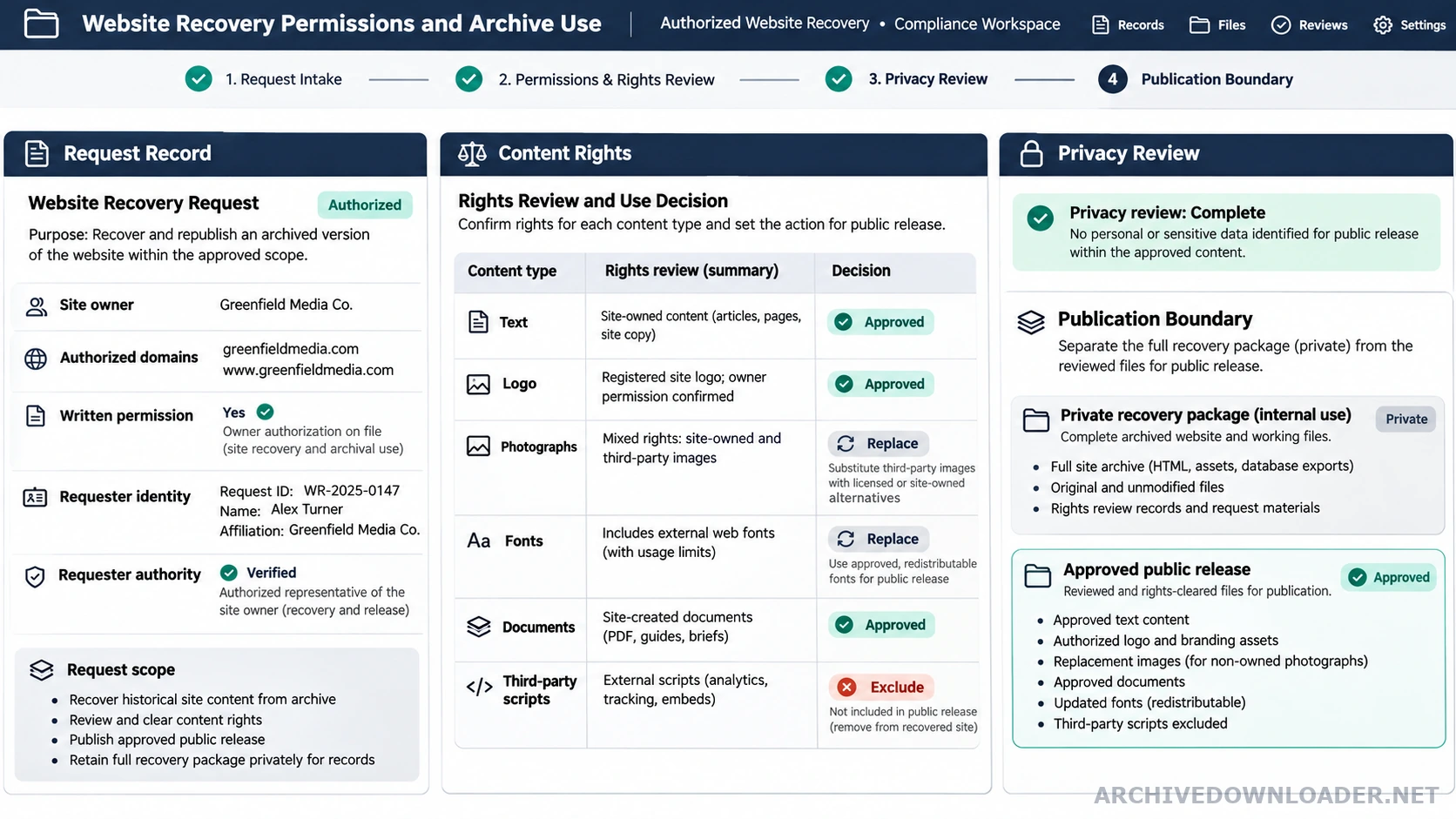
Record the requester, organization, domains, approved subdomains, historical period, intended use, and who can approve publication. Keep the written consent or ownership evidence with the project record. If a domain changed hands, confirm that the requester is authorized to use the historical material rather than assuming current control grants every historical right.
Translate the authorization into crawl rules. A permitted domain does not automatically include unrelated customer portals, partner hosts, file stores, or third-party services linked from its pages. The manifest should identify external dependencies without copying them into the delivery unless the scope and rights clearly include them.
Review rights item by item before republication
Separate ownership of the website from rights in photographs, fonts, video, documents, testimonials, logos, software, and licensed datasets. Record whether each high-risk asset will be retained, replaced with an original visual, removed, or reviewed by the owner. Archive availability is evidence of public access at one time, not a license for current reuse.
Check old offers, prices, warranties, addresses, phone numbers, staff profiles, legal terms, privacy notices, and regulatory claims. Historical accuracy does not make obsolete business information safe to publish as current. Preserve the unedited recovery package privately, then make publication decisions in a separate reviewed copy.
Handle personal data and interactive features cautiously
Look for names, email addresses, telephone numbers, signatures, account identifiers, tracking IDs, embedded form destinations, and downloadable files containing personal information. Remove credentials and tokens immediately. Ask the owner to decide which personal details remain necessary and accurate under the current purpose and applicable policy.
An old login, payment form, contact form, or account page should not be made active merely because its interface was captured. Disable it or rebuild it against a current security and data-handling specification. Before launch, obtain a publication approval covering the reviewed content set, replacements, exclusions, and newly implemented behavior. This guide supports project controls and is not a substitute for legal advice on a disputed right.
Authorization and publication review
Public archive access is evidence availability, not permission to restore or republish another party's content.
Authority to retain
- The requester's identity, relationship to the domain, approved hostnames, and written recovery scope.
- Ownership or license review for text, images, trademarks, code, fonts, and downloadable files.
- A privacy review covering personal details, old forms, customer information, and historical contact data.
Review record
An authorization record and publication checklist that identifies who approved the scope and which material requires removal or replacement.
Do not continue
Stop when authority is disputed, third-party rights are unclear, or archived personal information cannot be republished responsibly without further review.
Document the authorized scope
Only submit a domain after the owner, permitted use, and publication boundary are recorded.
Review the recovery intake