
Documented stack decision
We record the public evidence for the framework, CMS, rendering model, and server technology, including confidence and conflicting signals.
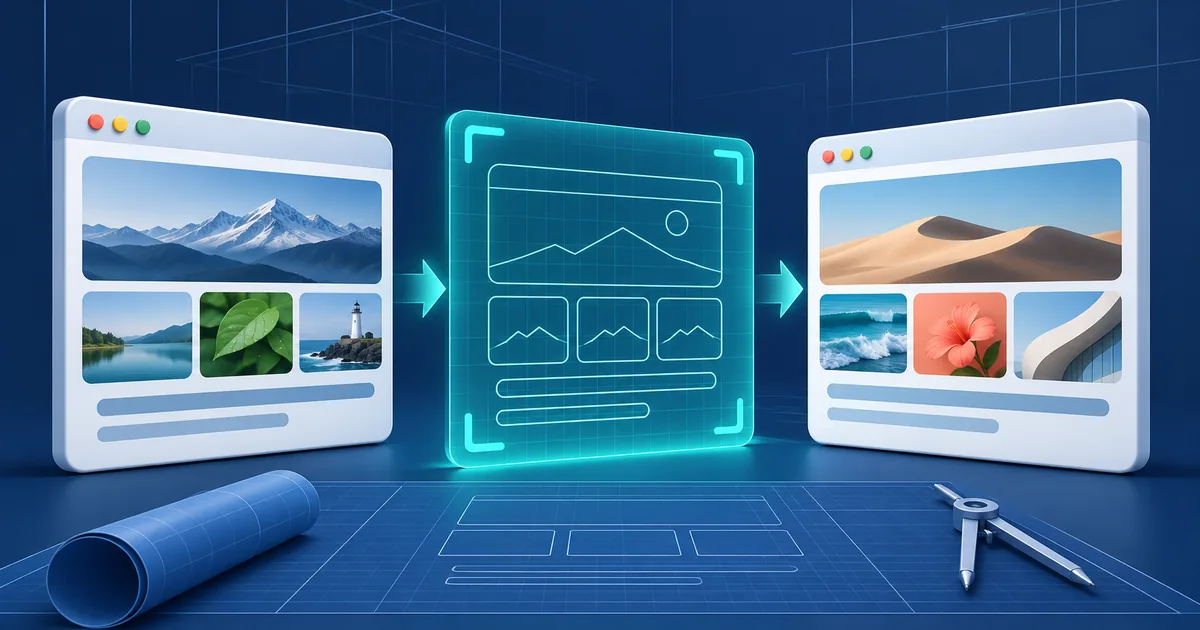
What the service creates: Clone Website reconstructs the public framework of an authorized live site in its detected technology stack. When that stack cannot be identified or reproduced, the fallback is portable HTML, CSS and JavaScript.
Use it for a live website you own or have written permission to reproduce, including reconstruction after losing hosting or administrator access. Source images are replaced with newly created original visuals.
The project recreates the maintainable framework of the authorized public site while keeping the delivered visuals original.
We record the public evidence for the framework, CMS, rendering model, and server technology, including confidence and conflicting signals.
Source image files are not copied. New simplified, contemporary visuals are made for the corresponding roles in the rebuilt pages.
The project uses the verified source technology when reproducible. If identification fails, it uses semantic HTML, maintainable CSS, and focused JavaScript.
An owner may still have a working public website after losing access to its hosting account, source repository, former agency, or administration panel. The public pages can provide evidence for reconstructing a new maintainable project. This is a reconstruction, not recovery of an unavailable database or private server.
Passwords, customer records, orders, form submissions, environment variables, unpublished files, private APIs, and original server code remain unavailable unless the owner supplies them separately. The delivered project identifies behavior that requires a new specification instead of pretending that private systems were copied.
Compare the available project formats and deployment options on the website rebuilding pricing page, or read how Archive Downloader documents authorized website reconstruction.
These answers define who may submit the website, what public evidence can be used, and what must be supplied separately by the owner.
No. You must own the website or hold written permission from the rights holder before submitting it.
The public website is rebuilt as portable semantic HTML, maintainable CSS, and vanilla JavaScript. Unavailable private and server behavior is documented rather than invented.
No. Source photos, illustrations, and other image assets are not copied. New original visuals are created for the rebuilt project.
It can reconstruct public pages when you own the site or have written authority. It cannot recover inaccessible databases, credentials, or private server code.
No. The work stays within public pages on the authorized hostname and does not bypass authentication or other access controls.