
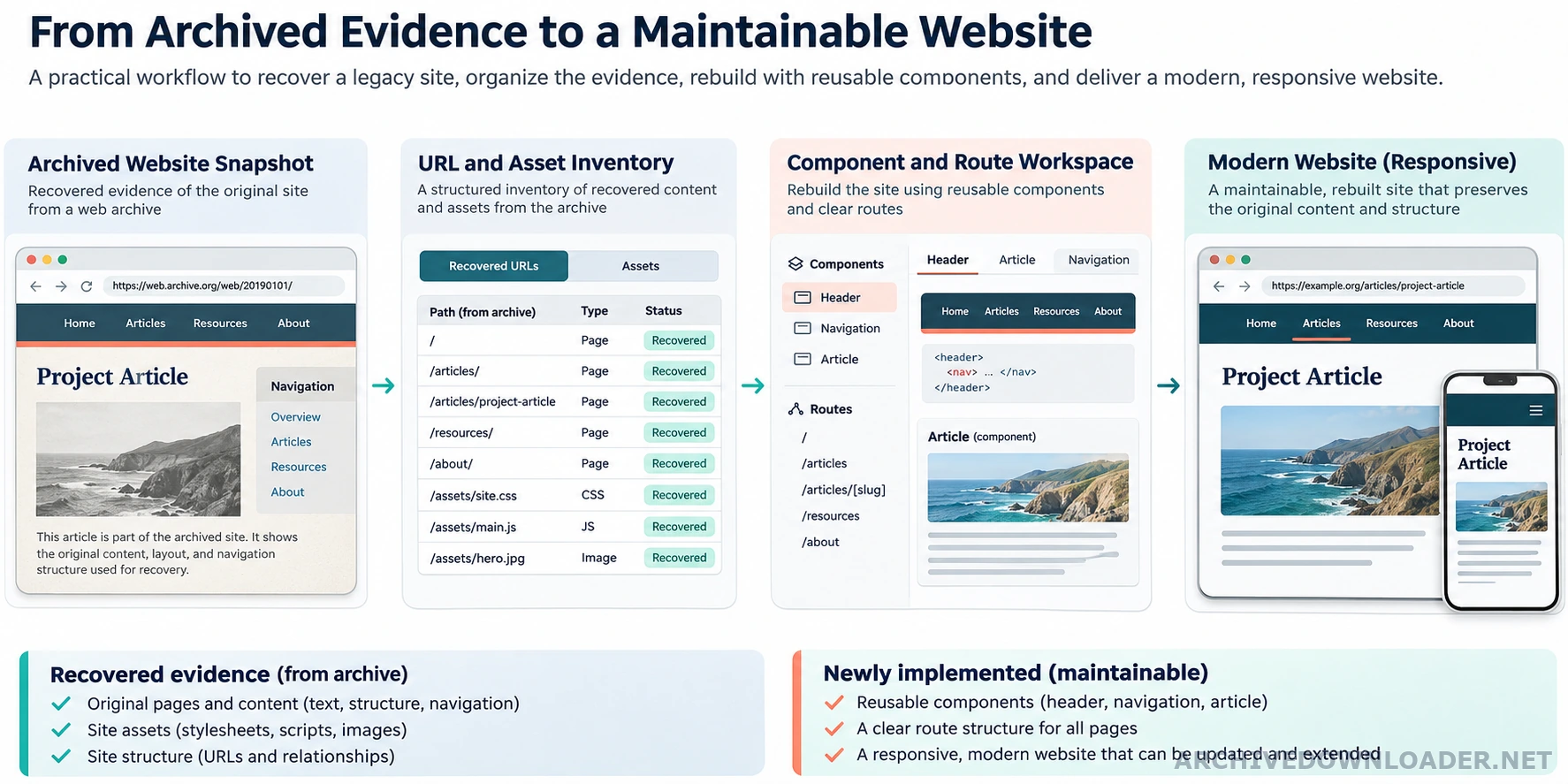
A four-layer rebuild model
Evidence layer
Immutable capture inventory, source files, checksums, and missing-resource records.
Content layer
Editable text, media references, metadata, and relationships separated from layout code.
Interface layer
Reusable routes, templates, components, navigation, and responsive behavior.
Behavior layer
Newly specified forms, search, accounts, and integrations that the archive could not preserve.
Separate recovery from modernization
First recover evidence of the old site. Then decide what should be reproduced, repaired, or redesigned. Mixing those decisions during the crawl makes it difficult to distinguish an archive gap from an intentional change. Use the website restoration workflow to separate recovered public files from features that need a current specification.
Create a URL inventory with status, capture date, template family, and priority. This reveals whether the archive has enough coverage to support a faithful rebuild before development time is spent. Before launch, apply the SEO checklist for a recovered website so routes, canonicals, redirects, and sitemap entries describe the new public site.
Reconstruct the site system
Group pages by layout rather than copying each page as a one-off file. Identify shared headers, footers, navigation, article templates, product templates, and forms. Rebuilding these as reusable components reduces inconsistencies and creates a site that can be maintained after launch. If maintainable source files already exist and only the framework needs to change, use the HTML website converter instead of rebuilding the website from archive evidence.
Use the archived site as source evidence, not as a reason to preserve insecure dependencies. Replace unsupported libraries, validate forms on the server, store secrets outside the repository, and add security headers appropriate to the new stack.
Prove the result
Crawl the rebuilt site and compare its URL inventory to the recovery manifest. Check internal links, image dimensions, canonical URLs, titles, headings, structured data, and redirect behavior. A representative page from each template family should be reviewed by a person who understands the original site.
Keep the recovery package immutable and version the modern implementation separately. That makes future corrections traceable and preserves the historical evidence that informed the rebuild.
Turn the URL inventory into a component plan
Add a template-family column to the recovered URL inventory. Compare page structure, navigation, repeated blocks, metadata, and content fields, then group pages that genuinely share a layout. A small site may need a landing page, article, listing, and contact template. A larger catalog may need product, category, search, and policy templates. The purpose is to model repeated behavior once, not to force unrelated pages into one generic component.
For each family, select a representative page with strong archive coverage. List the shared regions and the fields that vary. Record exceptional pages separately. This produces a component plan grounded in observed pages and prevents the team from creating a component for every URL or one oversized component controlled by dozens of route-specific conditions.
Specify dynamic behavior the archive could not preserve
Write a current requirement for every form, search box, account area, filter, checkout control, or data-backed widget. The specification should name the user action, validation rules, success result, error states, data owner, retention rule, and accessibility behavior. A screenshot or captured HTML can show placement and labels, but it cannot establish the private business logic or data that existed behind the interface.
Mark each feature as reproduce, redesign, disable, or remove. Reproduce only when the owner can supply reliable requirements and authorized data. Redesign when the historical behavior is unsafe or no longer fits the business. Disable with a useful explanation when the feature cannot be supported at launch. Remove controls that would otherwise create a false promise to users.
Create a handoff that another developer can maintain
The final project should include route definitions, reusable layouts, content sources, dependency versions, environment variable names without secret values, build commands, deployment instructions, and a known-limitations record. A new developer should be able to install the project from a clean checkout, run it locally, build a production artifact, and understand which features depend on external services.
Test the handoff on a clean environment rather than the machine used during reconstruction. Crawl the production build, compare route counts with the approved inventory, and test one page from every component family. Preserve the archive manifest beside the acceptance report so future corrections can cite a source capture, an owner-supplied file, or a new implementation decision.
Website rebuild planning checklist
Separate evidence recovery from new implementation so the team can distinguish historical material from current design and behavior decisions.
Inputs for the rebuild
- A route inventory grouped by template family and business priority.
- Examples of shared navigation, repeated content fields, forms, and application states.
- A list of obsolete dependencies and dynamic features that require a current specification.
Architecture record
A rebuild brief that maps recovered evidence to routes, reusable components, content sources, and acceptance tests.
Reconsider the plan
Stop when visual similarity is being treated as proof that forms, accounts, search, or checkout behavior has been recovered.
Choose the maintainable output
Compare the supported project formats before recovered pages are translated into routes and components.
Compare website formats