
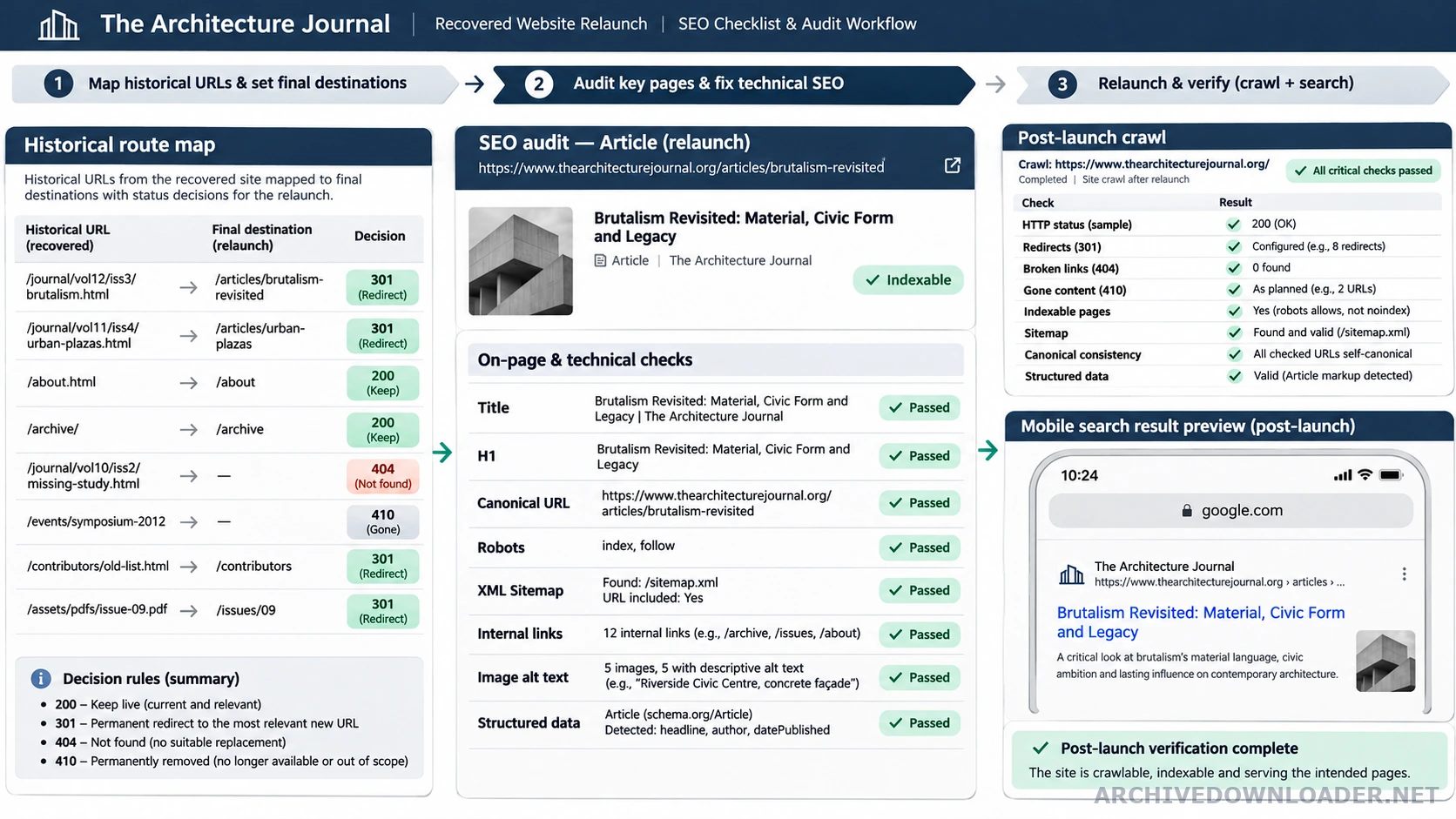
Release checks by signal group
- Routing: Every historical URL has a relevant final destination, deliberate 404, or deliberate 410.
- Indexing: Canonical successful pages are indexable; private, duplicate, parameter, and staging URLs are not.
- On-page signals: Title, description, H1, headings, links, image text, and visible content agree on one intent.
- Discovery: Internal links and the XML sitemap contain only final canonical URLs that return HTTP 200.
- Validation: A post-launch crawl confirms redirects, canonicals, status codes, mobile rendering, and structured data.
Inventory old and new URLs
- Build a table of historically indexable URLs, recovered content, intended new URLs, and final status. Preserve a path when it remains accurate and useful. Redirect a changed path to its closest equivalent, not automatically to the homepage. Use the website restoration workflow to decide which historical URLs have equivalent recovered destinations and which should remain 404 or 410.
- Return a real not-found or gone response when no replacement exists. A blanket homepage redirect conceals gaps from users, analytics, and crawlers and can be interpreted as a soft error. Then follow the static website deployment guide to verify public status codes, HTTPS, cache behavior, canonical URLs, and deep-route responses after release.
Remove archive-specific signals
- Replace replay URLs in internal links, canonicals, structured data, feeds, stylesheets, and scripts. Remove historical robots directives that no longer express the owner's intent. Generate a sitemap from the rebuilt public routes rather than copying an archived sitemap blindly. If the verified static package needs a maintainable framework project, compare outputs in the website stack converter before finalizing canonicals and sitemap URLs.
Review each template family
- Confirm one descriptive H1, an aligned title, useful meta description, crawlable navigation, meaningful image alternative text, correct status codes, and mobile readability. Keep staged, account, checkout, and internal search URLs out of the public sitemap.
- After launch, monitor server errors, redirect chains, canonical selection, index coverage, and top landing pages. Do not change article dates unless the content received a substantive update.
Build a URL decision table before editing metadata
- For every historically important URL, record the recovered source, final public URL, intended status, canonical target, indexability, page purpose, and redirect destination if it changes. Add traffic or backlink evidence when the owner has it, but do not preserve a thin or unsafe page solely because an archive index contains the address. One row should lead to one unambiguous release decision.
- Keep final 200 pages, specific redirects, and deliberate 404 or 410 responses separate. Remove redirecting, duplicate, noindex, parameter, and noncanonical URLs from the XML sitemap. A URL without an equivalent should not redirect to the homepage, because that hides the missing resource from users and can create a soft-error signal.
Audit search signals by template and by page
- At the template level, verify crawlable navigation, valid landmarks, one main content region, mobile rendering, image dimensions, accessible controls, and structured data that matches visible content. At the page level, align the title, H1, opening answer, headings, canonical URL, and internal anchor text with one clear intent. Unique metadata cannot rescue a page whose body provides no distinct value.
- Check that canonical tags use absolute final URLs and that internal links point directly to those URLs rather than through redirects. Use descriptive image filenames and accurate alternative text where an image conveys information. Keep decorative images out of the content narrative. Validate structured data, but treat it as a description of the page rather than a substitute for visible answers.
Verify discovery and indexing after launch
- Fetch robots.txt and the XML sitemap from the public host, then crawl the site as a signed-out user. Confirm that important pages return 200, are not blocked, use self-consistent canonicals, and are reachable through contextual internal links. Test redirect variants and query parameters so alternate URLs cannot create duplicate indexable copies or poison cached metadata.
- Monitor server logs, crawl reports, Search Console coverage, canonical selection, sitemap processing, and important landing pages. Investigate changes by URL group rather than reacting to one daily number. Update an article date only after a substantive content change, and keep a change record for redirects, page merges, removals, and major revisions.
Recovered website search migration checklist
Treat the relaunch as a current search migration instead of copying robots, canonicals, metadata, and redirect behavior from archived responses.
Signals to verify
- A one-to-one inventory of historical URLs, final destinations, content equivalence, and HTTP status decisions.
- Template-level titles, descriptions, H1s, canonicals, structured data, internal links, and image text alternatives.
- A sitemap containing only canonical successful pages and monitoring for errors, soft 404s, and unexpected canonical selection.
SEO release record
A launch workbook combining the URL map, template audit, sitemap inventory, indexation controls, and post-launch monitoring owners.
Do not launch
Stop when every missing URL redirects to the homepage, archive replay URLs remain in signals, or staging and account pages are exposed for indexing.
Prepare the recovered route map
Choose the final project format and keep historical URLs connected to their closest valid destinations.
Review output formats