
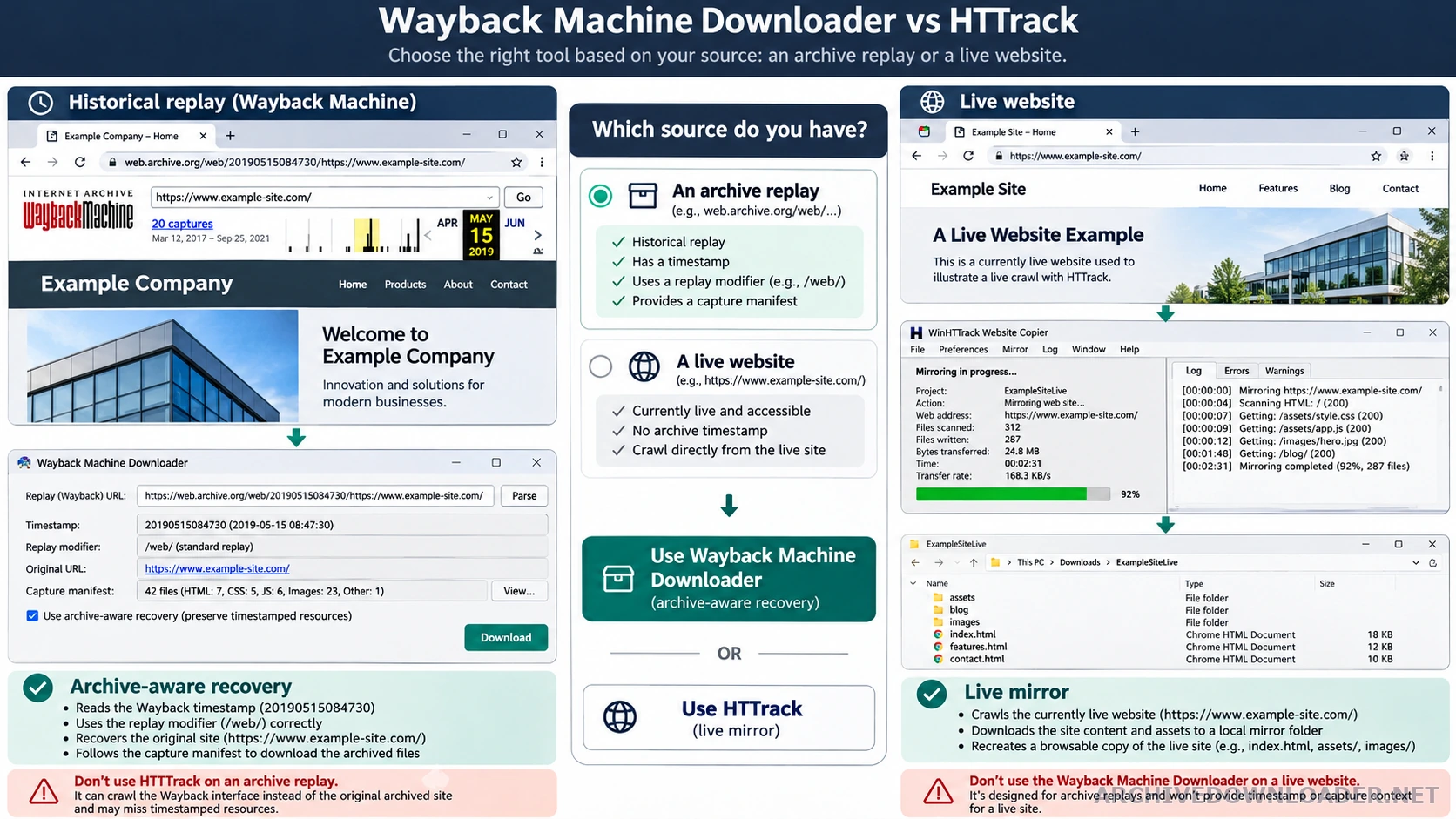
Match the downloader to the source
A live mirror and an archive recovery start from different evidence. Compare the source facts before choosing either workflow.
Intended source
- Archive-aware downloader
- Timestamped archive replays
- Live-site mirror
- A currently reachable live website
Time handling
- Archive-aware downloader
- Selects and records captures for each recovered resource
- Live-site mirror
- Requests the current response available during the crawl
URL treatment
- Archive-aware downloader
- Removes replay hosts, timestamps, modifiers, and archive interface code
- Live-site mirror
- Rewrites live links for a mirrored copy
Required evidence
- Archive-aware downloader
- Capture manifest and missing-resource report
- Live-site mirror
- Live crawl log and mirror validation
The source changes the job
HTTrack and similar mirroring tools are designed primarily to follow links and assets from a live website. A Wayback-aware downloader must understand capture timestamps, replay modifiers, archive redirects, toolbar additions, and links whose nearest valid asset belongs to another date. Choose the archive-aware path in the Wayback Machine downloader guide when timestamps, replay modifiers, and nearby captures affect the result.
Pointing a general mirroring tool at a replay can save archive wrappers and rewritten URLs as if they were part of the original website. The result may continue requesting Archive.org or create filenames based on replay paths rather than the original information architecture. For a bounded historical inventory, use the complete Wayback Machine website download guide to define scope and prove that the output no longer depends on replay services.
When a live mirror is appropriate
Use a conventional mirroring workflow when you control a live static site and need an offline copy of its public output. Respect crawl limits, authentication boundaries, licensing, and server capacity. A mirror still does not replace database and application backups. When the authorized source is a currently accessible website rather than an archive replay, use the live website cloning workflow so the current public technology stack can be identified and preserved.
When archive awareness matters
Use an archive-aware process when the live origin is unavailable or the target is a historical state. Require a capture policy, original-URL mapping, archive-dependency scan, and missing-resource manifest. Those controls are more important than download speed.
Choose based on the source, not the preferred interface
Use a live-site mirror only when the authorized source is currently reachable and the desired state is what the server returns now. Use an archive-aware process when the source is a timestamped replay or a historical state. If a site is live but the desired version is historical, crawling the live origin cannot substitute for capture selection and replay parsing.
Write down the source hostname, desired date, crawl boundary, authentication boundary, and required output before selecting a tool. This prevents a live crawler from wandering into an archive replay and prevents an archive downloader from being used as a substitute for owner-controlled backups of a functioning application.
Compare the evidence produced by each workflow
A live mirror should record request time, final URL, status, content type, local path, redirect, and exclusions. An archive recovery also needs the original URL, selected capture timestamp, replay modifier, substitution timestamp, and missing-resource decision. The extra fields explain how several historical observations became one coherent package.
In both cases, verify the output with a local server and external dependencies blocked. Crawl internal routes, inspect file types, and check representative templates. An archive package additionally fails if required links still point to replay URLs. A live mirror fails if it crossed the approved boundary, overloaded the source, or copied authenticated or licensed material outside the authorization.
Understand what neither tool restores
Neither a live mirror nor an archive downloader produces a private database, environment variables, server configuration, account records, or original application source merely by crawling public pages. Visible forms, search results, and checkout screens show interface evidence, not the protected systems that generated or processed them.
If the owner needs maintainable dynamic behavior, follow the mirror or recovery with a separately scoped rebuild. Use current requirements, authorized data, security controls, and acceptance tests. Keep the crawl package as evidence and avoid presenting newly implemented behavior as something recovered by the downloading tool.
Downloader selection criteria
Choose based on the source environment: a live origin needs controlled mirroring, while archive replay needs timestamp and original-URL interpretation.
- Source facts
- Whether the authoritative source is a working live site or a historical replay.
- Requirements for timestamps, replay modifiers, nearby captures, missing resources, and original path recovery.
- Proof that the delivered copy can run without the source server or archive replay service.
- Tool choice
- A tool-selection note defining the source, crawl boundary, URL transformation rules, and validation method.
- Wrong-tool signal
- Stop when a general mirror saves replay wrappers as site content or when either tool is being treated as a replacement for server and database backups.
Use the archive-aware workflow
Submit a timestamped Wayback URL when the source is a historical replay rather than a live website.
Open the archive downloader